

E50A Magneto Timing Light
Overview
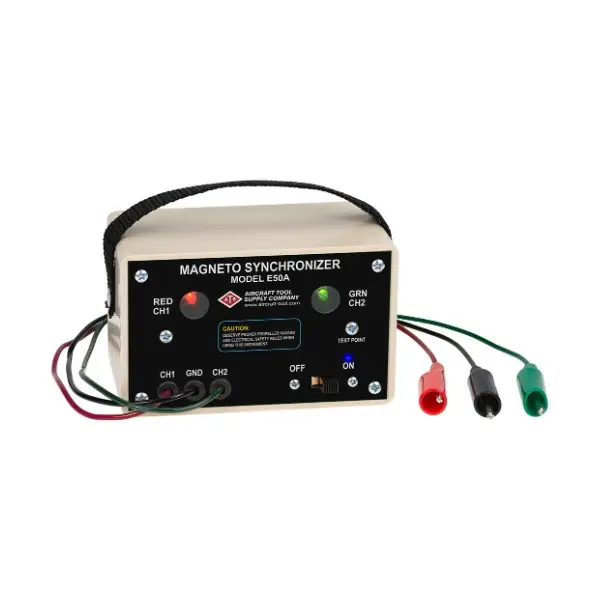
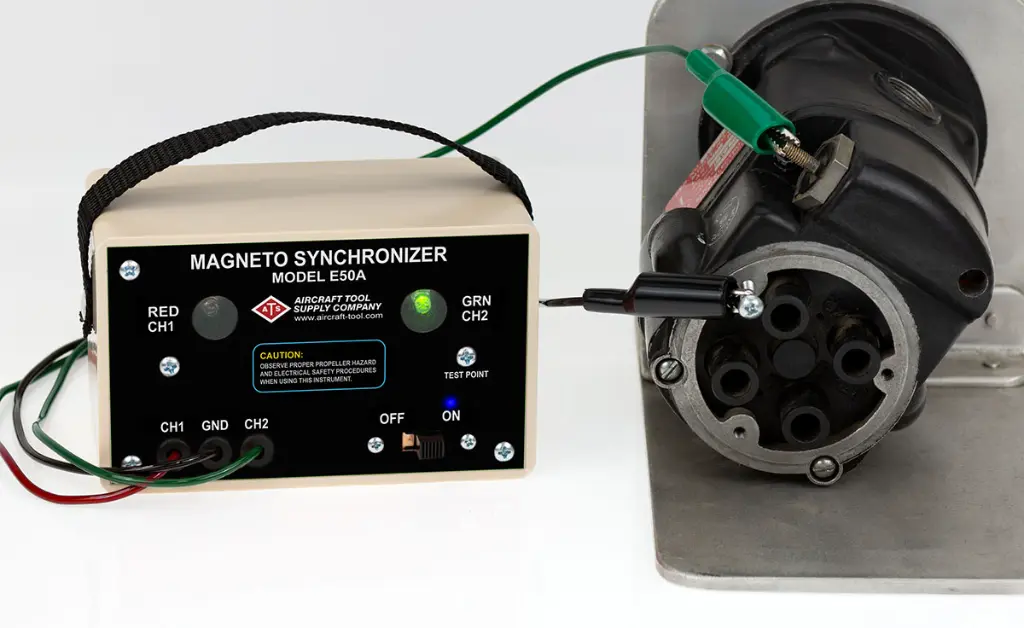
| The ATS E50A Magneto Synchronizer is a modern redesign of the classic test instrument used by aviation mechanics around the world for over 50 years. It uses surface-mounted (SMD) micro-circuitry to eliminate the need for the bulky vibrator, and heavy transformers. The new technology of the E50A uses low voltage signals to measure the inductance of the magneto and precisely detect the moment the points break, without any false readings. The ATS E50A also features enhancements to make your job easier, such as a Built-In Calibrated Test Point to validate your tester before each use; a battery monitor to give you plenty of warning before your tester runs out of power; and Quiet-Mode operation that alerts you only when the points break - so no more annoying "buzz-box" always screaming at you when you're trying to do a test. |
Model Differences
- I don't see any lights or hear the buzzer when I turn the unit on (as with the older models).
- If you're familiar with older models of the E50, then this new behavior might stump you at first, but it's by design. When we re-engineered the E50A we believed that it simply made more sense to give the user a consistent positive indication when the points break, instead of the sometimes confusing mixed indications of the older models. I was able to short the leads with the older E50 models to get a response, but I cannot with the new E50A. Also, why is the test point necessary?
The ability to short the leads of the older E50 model and have the light go out was simply an oddity of that design. It is not, nor was ever intended to be, a CONTINUITY TESTER, which is how you are trying to use it when you short the leads and expect a response.
The new E50A measures the INDUCTANCE of the magneto coil, which is the correct way to test the magneto. Therefore, if the magneto has excessive resistance (over 100 Ohms), which may be due to burned windings or poor internal connections, the new E50A will rightly not respond to the fault. Similarly, if the magneto has very low inductance (less than .01mH), which may be due to internal shorting or a failure of the bypass capacitor, the E50A will again not respond until the fault condition is resolved.
So, in short, the new E50A is designed to work only when the following conditions are met:
- It is properly hooked up to the magneto
- The magneto does not have high resistance (> 100Ohm), indicative of open windings.
- The magneto does not have low inductance (< .01mH), indicative of shorted windings.
The older E50 models were able to detect fault conditions (a) and sometimes (c), but they could not detect fault condition (b).
The onboard TEST POINT is designed to be an electronic approximation of an actual magneto's primary circuitry (i.e. similar inductance, capacitance, and resistance). So, using the test point is the best way to confirm the operational capability of your E50A prior to application.
Features
- All Solid-State Design
- On Board Calibration Tester
- Dual Independent Channels
- Warns When Battery Runs Low
- Quiet-Mode Operation
These products might also be of interest