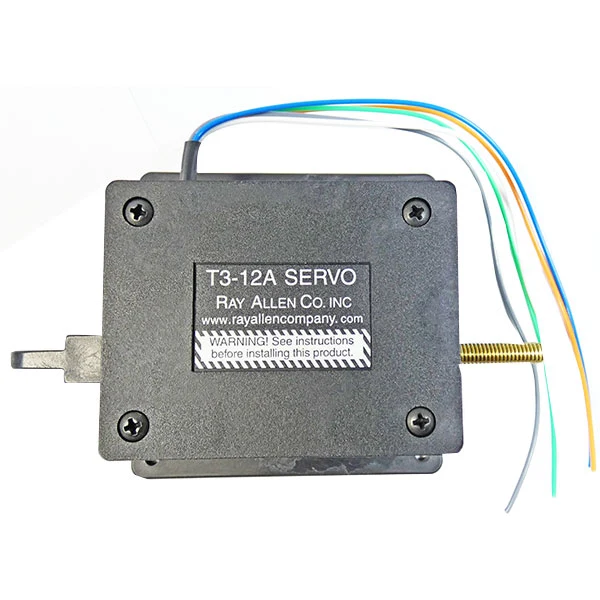
Image for illustration only. It may show a product series rather than the exact product offered.
RX1-11-02058
T2-10A Rac Servo Only
261.34 EUR/EA
Excluding VAT
Availability
AOG
AOG service might be available even outside our opening hours. AOG services incur a fee starting from 100 EUR.
Accept and see AOG contact details
Part numbers
- Roctexo
- RX1-11-02058
- Manufacturer
- T2-10A
- Vendor
- ASS-11-02058
- Vendor
- 11-02058
Product details
| RAC Servo Sys. | Part No. | Output Shaft Movement | Travel Time |
|---|---|---|---|
| T2-10A | 11-02058 | 1.0 in. | 16 sec. |
Overview
| Ray Allen servos were designed specifically to control trim surfaces in homebuilt aircraft. They can also be used to operate other mechanisms within your aircraft, thus eliminating the need for bulky cables and pulleys. Ray Allen servos operate on 12-14 volts DC. When activated they push or pull with tremendous force. Since this thrust is generated by means of a jackshaft (T2 series) or a jackscrew (T3 series), the output shaft will lock in any position when the electrical power is off. They will automatically stop when their travel limit is reached. No electronics are used to control Ray Allen servos and they will not travel unless power is switched on by the pilot. Voltage polarity determines the direction of travel. Ray Allen has three different T2 and T3 servos available: T2-7A servo has .7" (17mm) travel T2-10A servo has 1.0" (26mm) travel T3-12A servo has 1.2" (31 mm) travel The miniature T4-5 is designed for installation in very small ailerons and rudders. It is not recommended for elevator trim. The internal working mechanism is, in principle, the same as that used in the T3 series servo. |